

Rite of Passage
By Paul Brisso
A marvel of a safari is that even when things don’t go exactly as planned or intended, there can be benefits that pay dividends in the future. Mistakes or mishaps on today’s safari may provide a learning experience that result in future safari success rather than disappointment.
Because even the most seasoned hunter is almost always the least experienced member of the safari team, usually the hunter is the beneficiary of lessons learned the hard way. However, sometimes the professional hunter learns something new, and even more infrequently, maybe even a highly skilled native tracker on safari experiences something he has never encountered before that will provide insight on a future hunt.
But on my recent safari with Carl van Zyl of John X Safaris, it was Carl’s one-year-old wire-haired terrier, Chili, who was the beneficiary of less than ideal circumstances.
After taking our exceptional Bushbuck in the Komga area, our team traveled about three hours to the Cathcart area to hunt a “right proper Eland” and to use as our home base for pursuit of Vaal Rhebuck. Our accommodations for this portion of the hunt was Lalapa, operated by Theo and Diana Kemp.
While hunting in the Grahamstown area of South Africa’s East Cape, Carl uses his family’s first class game reserve as his base of operations. But great trophy quality is Carl’s top priority and depending on the species you’re hunting he may use exclusive lease properties in other areas. However, when he does, he makes sure his hunters still have exceptional lodging, meals and hosts at the end of the hunting day.
Lalapa was no exception. Our sleeping quarters were a picturesque rock bungalow duplex in a quiet and remote setting with king bed and separate bath. The lodge had separate areas for sitting, bar, and dining, but flowed comfortably as an integrated unit. But what really makes Lalapa special are the warmth of Theo and Diana. I would travel back to South Africa just to share some more time with them at Lalapa again.
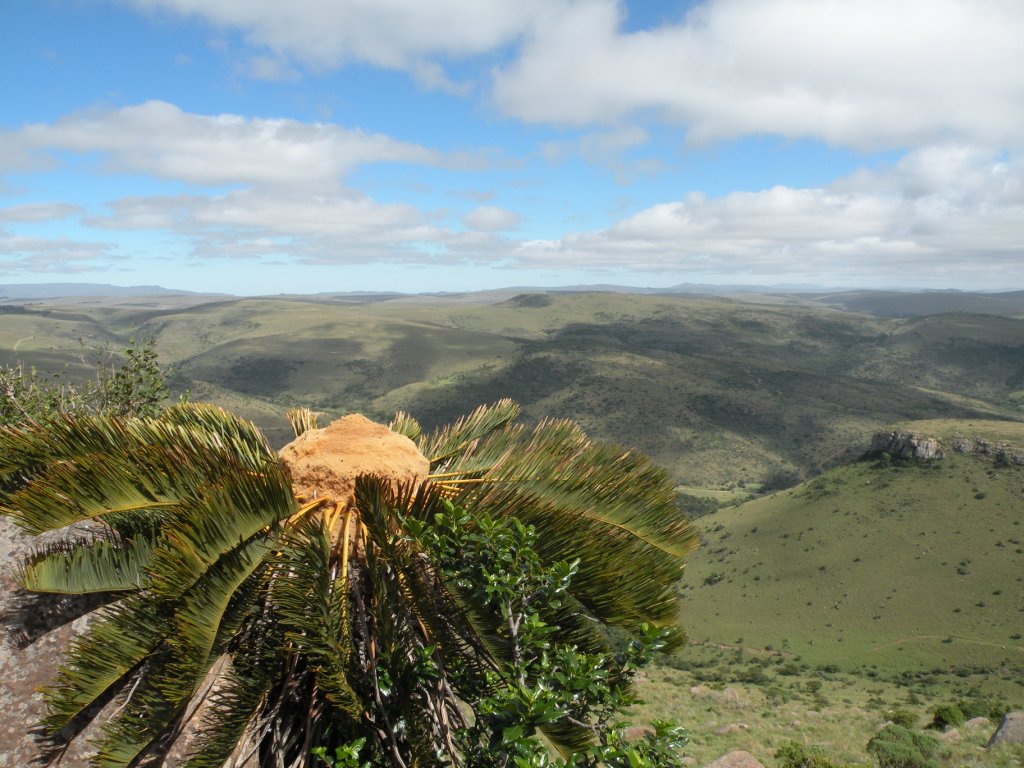
Our first day hunting for a “right proper Eland” was on a nearby reserve. Teresa experienced a different type of hunting than the limited visibility, thick, jungle-like brush where we had hunted Bushbuck. It was more in keeping with the experience she had expected on her first safari. We traversed valleys and encountered Waterbuck, Impala and Nyala. We climbed up ridges and hills and enjoyed panoramic vistas, often observing herds of Black Wildebeest with lone Wildebeest bulls hanging around the fringes. Herds of Zebra, rare Bontebuck and groups of Springbok, were all keenley observed and enjoyed from various vantage points. We saw a herd of approximately 30 Eland, including several bulls. One was close to being a “right proper Eland” but we passed (a decision we questioned later that evening at the lodge after a closer look at the video).
As late afternoon faded into early evening, we decided to head for home and resume the hunt for Eland the next day. As we started to work our way down the mountain where we had ended our Eland search, Carl spotted a bedded lone Springbok. Having seen a super old loner ram in the area in the past, Carl stopped to give it a closer look. He confirmed it was the ram he had seen before. We decided we needed to try to take advantage of this opportunity.
The terrain was very open. We first thought we could make a long loop around and get within a reasonable range, but by the time we got to our objective the ram had either gotten our wind in the swirling evening breeze or had decided to move off for one reason or another. After relocating him and some additional stalking, we came up on him at about 150 yards but he was moving away. Carl kept hoping the ram would stop, but he walked on for some distance before stopping and turning to give an acceptable shot.
It was not a really bad shot. The ram was a bit further than I thought and I was unfamiliar with the rifle. I was shooting Carl’s 300 Win Mag Winchester, having left mine at home since we had played tourist for about a week prior to meeting up with Carl for the hunt. The shot was on-line, but about four inches low. However, because the vital area of most African antelope is further forward and lower than most North American species, and the relatively small size of the Springbok, four inches low resulted in a broken upper front left leg rather than a good hit or a clean miss.
Like all hunters, I hate not making a clean immediate one shot kill. Although I was dismayed, I was not discouraged. The ram was badly wounded, the country was very open and visible, and we had a fair amount of daylight left. We made another loop to get above and in front of the ram and came upon him again at about 50 yards with one of the few trees in the area between us. I sighted in for a finishing shot and fired, expecting the ram to drop immediately. I could not believe it when the ram buckled but did not drop, and took off running again. My bullet had struck a branch of the tree I did not see in the scope and deflected.
As we had made our loop to intercept the ram Chili, Carl’s year-old wire-haired terrier, still really just a puppy, was tagging along with us. She had previously participated in baying up wounded game with a more experienced “brother” Bongo, Carl’s Jack Russel Terrier, but had never taken on an animal by herself. Upon my miss of the attempt to finish off the ram, Carl put Chili on the track. Chili was after the Springbok in a flash and soon had it bayed. As the African night quickly approached, we made short work of finishing the previously botched job.
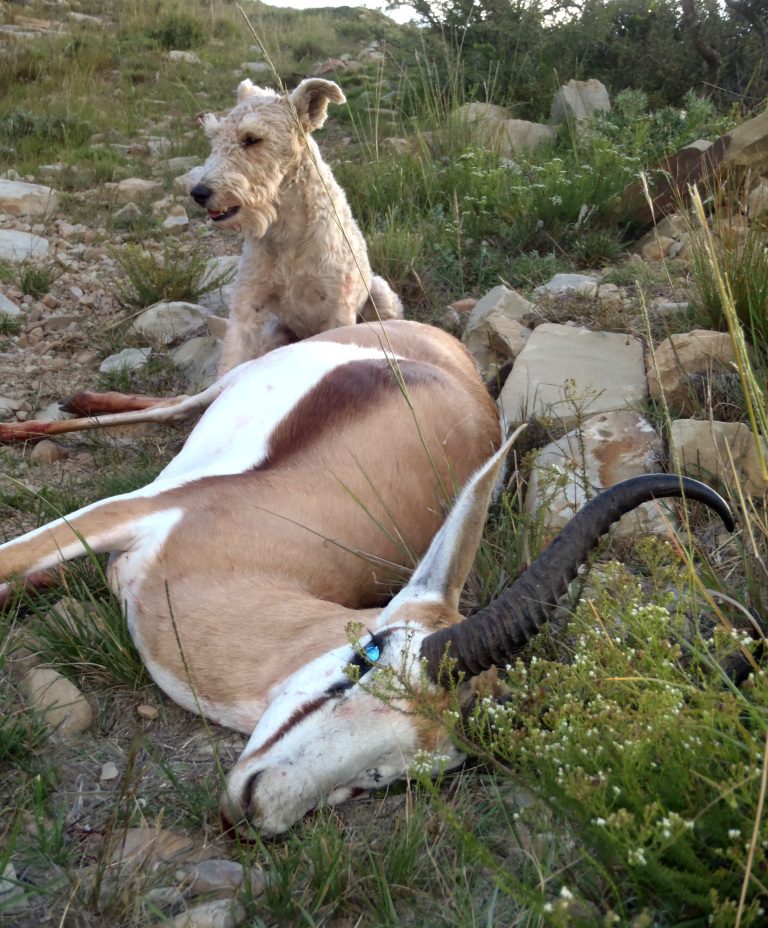
As we recovered the downed ram, took photos, and prepared to transfer it from the field, Chili was obviously and rightfully proud of herself.
She had completed the rite of passage from puppy to safari hunting dog with flying colors. Although my shot was less-than-perfect and I wish I had done a better job, my failure gave Chili the opportunity she needed.
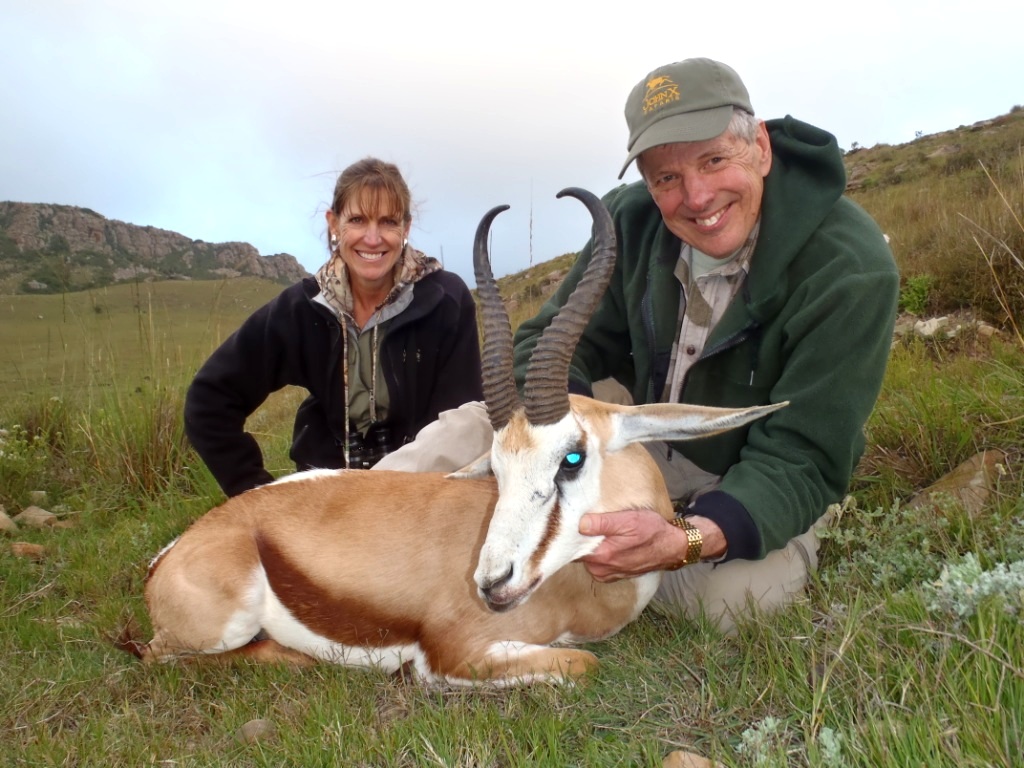
I take solace in the fact that Chili’s experience will no doubt result in the recovery of wounded game on future safaris, to the benefit of the animals that need to be recovered and to the benefit of future hunters who, like me on this day, sometimes fail to make the perfect shot.
For more information and current updates about John X Safaris; follow us on Twitter, connect with us on Facebook, subscribe to our YouTube Channel and visit our Website!